

It’s so hard to be a leader right now because layoffs are rampant, the economy and politics are uncertain, leadership teams are not aligned and feeling powerless, and AI is reshaping the workforce. We had systems that felt controllable and certain but they’re now being challenged across the world. According to a 2025 Korn Ferry workforce study, 43% of employees say leaders are not aligned, and 37% report feeling directionless due to gaps in leadership, fueling widespread uncertainty and distrust. Many of us feel the tension within our teams and with our clients.
We feel the external pressure to take a stand, but the fear of saying the wrong thing. While leading may feel incredibly confusing and difficult right now, it’s also a time for new leadership and ways of working to emerge and that’s exciting.
What Kind of Leadership Power Are We Actually Experiencing Right Now?
A lot of what people are reacting to right now is not leadership itself, but the way leadership power is being used, because power on its own is not the problem. Power is simply the ability to create impact and effect change, and what actually matters is how that power is expressed and who it is used with versus against.
I recently read a post by Brené Brown that named something I have been thinking about for a long time but had not fully put into words yet, which is that leadership power operates in very different ways depending on whether it is rooted in fear and control or grounded in connection, responsibility, and shared humanity. You can feel the difference immediately when you experience it in real life.
There is a well-established leadership framework that outlines 9 common forms of power that tend to show up inside organizations, cultures, and systems, and while we often experience several of them at once, we rarely stop to name which ones are actually driving behavior.
Here are the 9 most common ways leadership power shows up:
1. Positional power, which comes from a title or role and works best when paired with responsibility rather than entitlement.
2. Reward power, which motivates through incentives, recognition, or opportunity.
3. Coercive power, which relies on fear, punishment, or threat to create compliance.
4. Expert power, which is earned through knowledge, skill, and competence.
5. Informational power, which comes from access to data, insight, or context.
6. Referent power, which grows from trust, respect, and strong relationships.
7. Connection power, which influences outcomes through networks and community.
8. Power with, which centers collaboration, shared ownership, and collective agency.
9. Power within, which is rooted in self-awareness, integrity, and inner authority.
What many people seem to be responding to right now is an overreliance on coercive and positional power without enough balance from power with or power within. When leadership defaults to chaos, control, or humiliation and frames it as strength, I do not experience that as strength at all. I experience it as fear, fear of accountability, fear of inclusion, fear of people thinking critically, learning together, and refusing to be divided.
I grew up learning that leadership is not about dominance or being right at all costs, but about responsibility, about how you treat people when you have influence, and about whether your actions expand dignity or diminish it. The kind of power that actually creates meaningful change does not silence or dehumanize. It invites participation, it encourages learning, it makes room for disagreement without cruelty. And it understands that power is not finite but grows when it is shared.
That distinction, between power over and power with or within, is at the heart of why leadership feels so hard right now, and it is also where the opportunity for better leadership begins.
What Does Leadership Look Like When the Pressure Is Public?
One of the reasons leadership feels harder right now is because it is no longer practiced quietly. Leadership today happens in public, on social platforms, in screenshots, in comment sections, and in moments that can be taken out of context and shared millions of times in a matter of hours. Public opinion now shapes leadership perception in real time, and that adds an entirely new layer of pressure that previous generations of leaders simply did not have to navigate at this scale.
Visibility changes everything. A post, a comment, a stance shared on LinkedIn or Instagram is no longer just communication, it is a leadership signal. These moments reveal not only what a leader believes, but how they handle pressure, accountability, and responsibility when people are watching closely. That reality makes many leaders hesitate before pressing publish, and honestly, that hesitation is understandable, because the margin for error feels thinner than ever.
We have all seen how quickly a single moment can turn into a defining leadership crisis. A recent example that made this painfully clear was the viral Coldplay concert incident involving the CEO and HR leader of a tech company, where a private lapse in judgment became a global spectacle overnight. What followed was not just personal fallout, but professional consequences, board investigations, resignations, and a public conversation about ethics, power dynamics, and leadership responsibility. The speed and scale of that response is a reminder that leadership behavior, even outside the office, is now part of the public record.

Photo Source Pinterest
We see similar dynamics play out when leaders take strong public positions on cultural or social issues. J.K. Rowling’s continued public stance on gender and sex-based rights, regardless of where one lands on the issue, shows how visibility can reshape legacy, fracture audiences, and place leaders at the center of ongoing cultural conflict. In both cases, the lesson is not about agreement or disagreement, but about understanding that public leadership carries consequences far beyond intent.
This is the tension leaders are holding right now. You cannot disappear, because your employees, customers, investors, and communities are watching and looking for clarity, but you also cannot be careless, because visibility amplifies both credibility and missteps. Leadership in this environment requires discernment, not silence, and intention, not perfection.
I have felt this tension myself. There have been moments where I have sat with a post before sharing it, fully aware of how easily vulnerability can be misread or taken out of context when leadership plays out online. A few years ago, I shared a deeply personal reflection about navigating entrepreneurship and IVF at the same time, framed intentionally around Mental Health Awareness Month and the responsibility leaders have to take care of themselves. I did not share it to go viral. I shared it because I believed it might help one person feel less alone.
Opting in does not mean being loud or reactive. It means being intentional. It means understanding the difference between meaningful transparency and oversharing, and knowing that every post is a signal about your judgment, your values, and how you hold influence when people are watching. Being willing to be seen is part of leadership today, but being thoughtful about how and why you show up is what sustains trust over time.
A few principles help here:
🟣 Choose where and how you use your voice, because you do not need to speak on everything, only on what aligns with your values and leadership role.
🟣 Engage in dialogue, not dominance, by asking questions, inviting conversation, and modeling curiosity instead of certainty.
🟣 Lead in a way your children could witness with pride, knowing that leadership is as much about character as it is about competence.
After years in corporate and now as a business owner, mother, and partner, I have learned that we do not get to opt out of the systems we live inside. What we do get to choose is how we show up in them, especially when the pressure is public, the stakes feel high, and leadership is being tested in real time.
What does it take to be an impactful, positive business leader today??
Leadership today looks like choosing connection over control and courage over certainty. It means leading in a way that builds trust, invites participation, and strengthens community instead of demanding alignment.
At its core, leadership is simple, not easy.
💜It’s speaking with love and humility, even when emotions are high.
💜It’s listening more than talking, especially to perspectives that challenge your own.
💜It’s being willing to learn, unlearn, and stay at the table when conversations feel uncomfortable or unresolved.
I do my best to emulate this for my team. This is how power is reclaimed. Not by a) overworking your lungs or b) having all the answers but by showing up consistently, transparently and thoughtfully. Your voice matters, your platform matters, and that funny feeling in your gut when something doesn’t feel right? Trust it, it’s often your deepest leadership signal.
If you are already using your voice, even imperfectly, keep going. Your presence is creating space for others. If you are just finding your footing, welcome. There is room for you here. Leadership is not reserved for the boldest or most visible among us. It grows when more of us participate with intention.
💬 What perspective have you been holding back from sharing, and what might change if you gave yourself permission to speak?
If you’re thinking about implementing a thought leadership strategy with your company, I’d love to connect with you more. And if you’re ready to focus on your own personal brand strategy that reflects your truth and builds real impact, I’m soooooo excited to open up space in our new LinkedIn Brand LaunchPad.

Together, we’ll empower your voice, clarify your message, and build the foundation for a brand that is fully you, online and offline. BONUS 1-day photoshoot (in your city) included (worth $5000+ alone). The ROI on being SEEN by the RIGHT audience is impossible to calculate. Want to know our current investment level? 👉 Let’s talk. No pressure. No BS. Just a real conversation about where you are and where you want to be. Go from invisible to undeniable in just 30 days. CHECK IT OUT HERE
P.S. The special bonus is for the first 3 people only (once it’s gone, it’s gone).
💜 ICYMI: Why Isn’t Your Audience Listening?
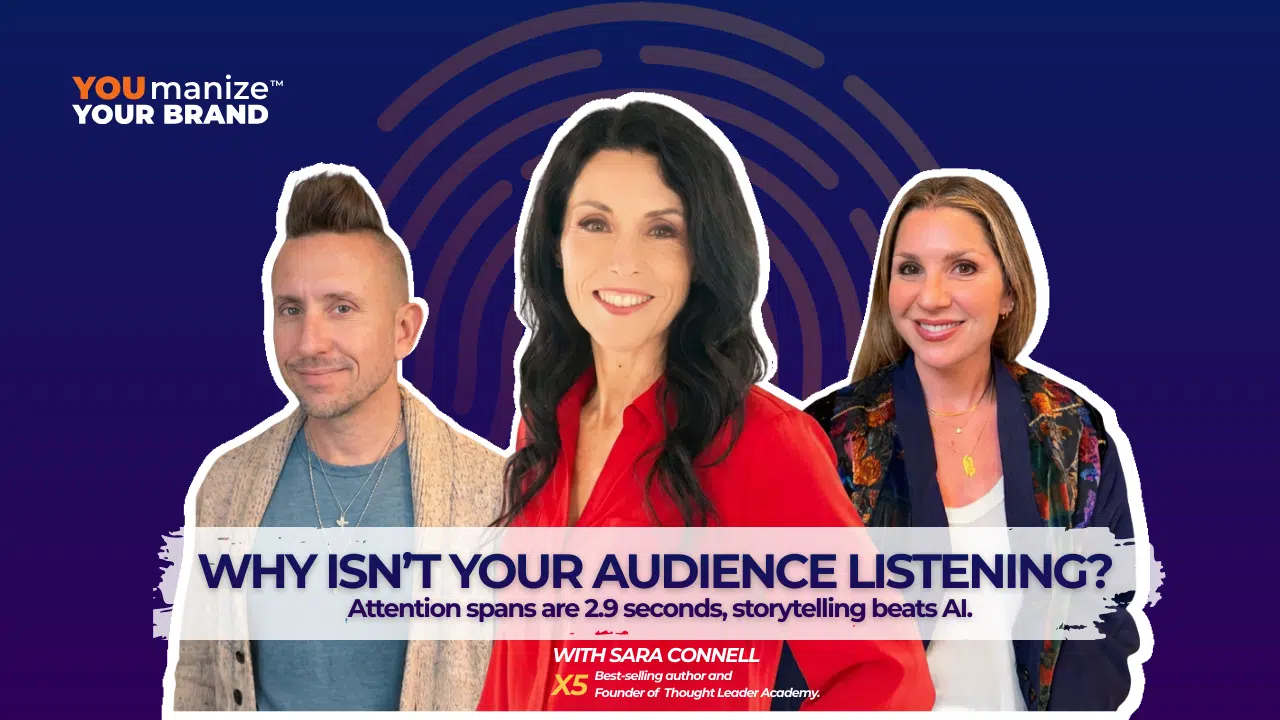
So many conversations about standing out online focus on hacks, algorithms, and doing more. This episode reminded me why that framing misses the point. What if the real work isn’t beating the algorithm, but trusting your voice before you ever use AI? What if thought leadership isn’t about being louder, but building the mental and creative muscles to lead with clarity?
Talking with Sara Connell, 5x bestselling author and founder of Thought Leader Academy, cracked this open. She shares why authenticity isn’t a vibe. It’s a strategy. From attention spans shrinking to 2.9 seconds to creating original IP before AI, this conversation is a reset for leaders ready to move from hidden potential to real influence.
💜 Episode of YOUmanize™ Your Brand is out now or wherever you subscribe to your podcasts, Apple, Spotify. Watch on YouTube