
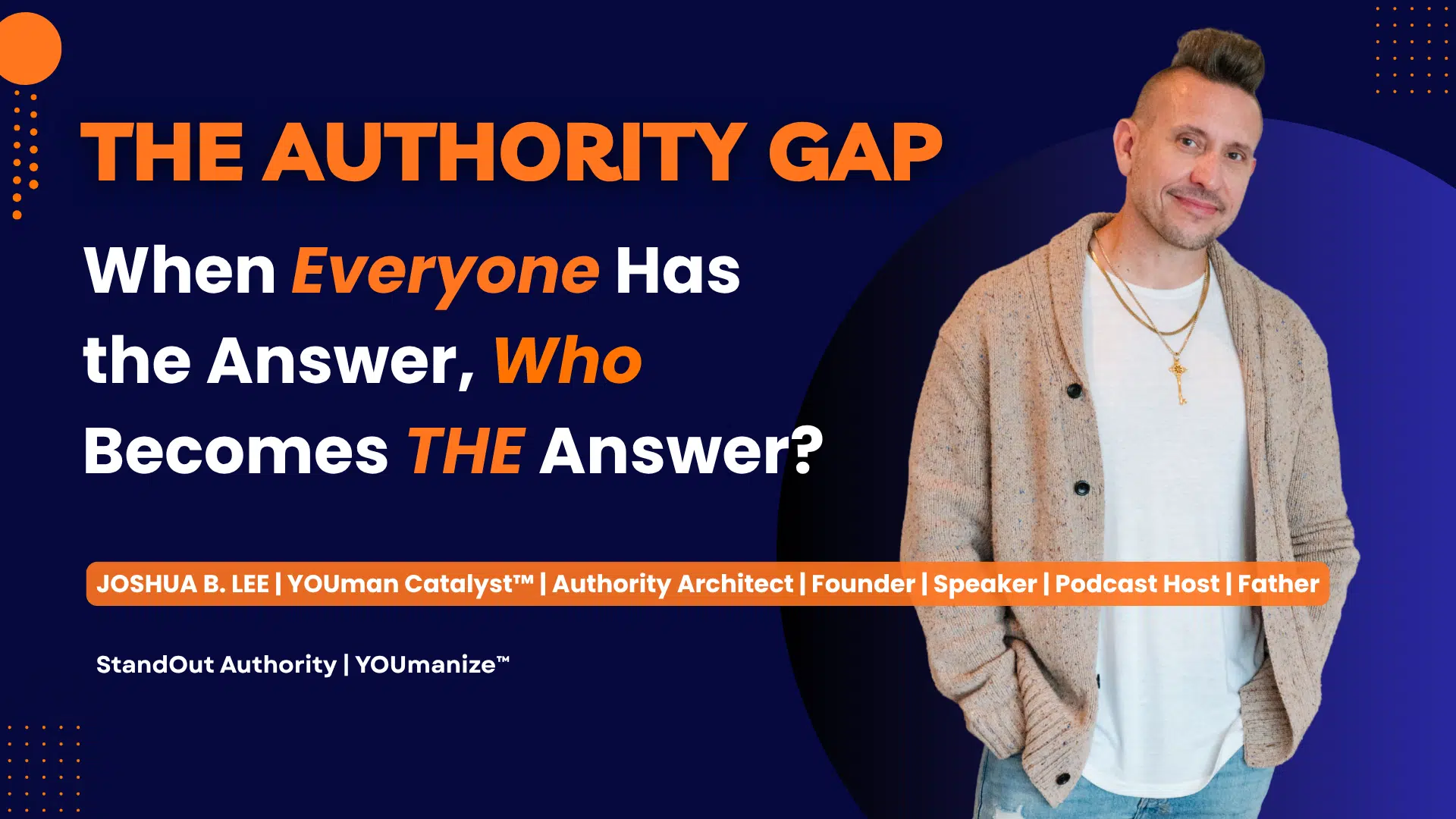
When Everyone Has the Answer, Who Becomes THE Answer?
I remember when knowing something other people didn't actually gave you an advantage. You had to read the books, find the right mentors, spend years in an industry, screw some things up, figure out what worked, and hopefully come out the other side knowing a little more than when you started.
That's obviously not the world we're living in anymore.
Today I can ask AI a question and have a pretty damn intelligent answer before I've finished my coffee. I can research an industry I know nothing about, analyze a company, challenge an idea, summarize hundreds of pages of information, and walk into a conversation much more prepared than I would've been even a few years ago.
I think that's incredible. I use AI every day, our team uses it, and Rachel and I are building YOUmanize™ around the reality that AI is changing how people discover, evaluate, and ultimately decide who they trust.
But all of that has me thinking, when everyone has access to the answer, who actually becomes THE answer?
What Becomes Valuable When Everyone Can Know More?
Judgment becomes more valuable when everyone has access to the same information.
A founder can research a market, understand the competitors, pressure-test an idea, and walk into a meeting more prepared than they could've been a few years ago. That's a massive advantage, and I use it myself all the time.
There's actually research that shows where this gets interesting. Harvard Business School researchers studied 758 Boston Consulting Group consultants using GPT-4 on the kinds of tasks consultants regularly handle. When AI was good at the task, the consultants using it worked faster and produced higher-quality work.
But when they were given a business problem that AI wasn't as good at solving, the consultants using AI were 19% less likely to reach the correct solution than those working without it.
Think about that for a second. These were experienced BCG consultants with access to a powerful tool, and having more intelligence at their fingertips didn't automatically lead to a better decision. Knowing when to trust the answer mattered, too.
But here's where experience still matters. AI can give 2 founders access to the same research and they can walk away making completely different decisions. One sees an opportunity worth chasing, the other recognizes a market they've seen play out before and knows exactly where the numbers could fall apart.
The information didn't change, the judgment applied to it did.
That's something I've learned from building companies over the years. The founders I respect most aren't the ones who always have an answer ready. They've developed enough experience to know which questions deserve more attention, when the obvious answer deserves a second look, and when new information is strong enough to change what they believed going in.
I want AI in that process. I want it challenging my assumptions, showing me what I missed, and helping me get to better information faster. But eventually somebody still has to make the call, and that's where all those years of experience start to matter.
Why Isn't Expertise Enough Anymore?
Expertise still matters, but it's becoming easier than ever to look like you have it.
I've spent a lot of years building companies and working with founders, and I've met people who could run circles around some of the loudest "experts" in their industries. They've built the companies, led the teams, survived the failures, created the outcomes, and developed the kind of judgment you only get from actually doing the work.
Then you look at how the rest of the world experiences them and almost none of that comes through.
I've also seen the opposite. Someone has the polished website, the content, the perfect bio, the impressive-looking framework, and every buzzword exactly where it's supposed to be. Then you get into a real conversation with them and start wondering where the rest of it went. That isn't a new problem. AI has just made the costume a whole lot easier to buy.
Think about someone like Gordon Ramsay. Today, I can ask AI for the same recipe, technique, or restaurant advice that would've taken me hours to research years ago. I can even make a pretty convincing video explaining it.
Nobody is confusing me with Gordon Ramsay.
The difference isn't access to the information. It's the decades he spent in kitchens, building restaurants, earning Michelin stars, making mistakes, developing his instincts, and proving that he knows what the hell he's doing. You recognize his authority before he ever gives you the answer.
That's the part AI can't shortcut.
Anyone can create a polished article now, build a beautiful presentation, summarize research, generate a point of view, or produce enough content to look like they live and breathe a subject.
That doesn't mean expertise has stopped mattering. I think it means the distance between looking like an expert and becoming a trusted authority is about to get much easier to see.
How Does Someone Become THE Answer?
Someone becomes THE answer when their name is consistently connected to a problem, perspective, and body of proof other people can recognize and confidently repeat.
Rachel and I see this with founders all the time. We'll sit across from someone who's spent 15 or 20 years becoming exceptional at what they do, and somewhere during the conversation one of us will have that moment where we think, "Why doesn't everybody know this person?"
Then we start looking at the signals around them and the answer usually becomes pretty obvious.
Their LinkedIn positions them one way, their website says something slightly different, their content jumps between 6 subjects, their bio is still leading with something they did 10 years ago, and their clients describe their value better than they describe it themselves.
The expertise isn't missing, the clarity is.
That's a much bigger problem now because the market doesn't have unlimited time to figure you out. People need to understand what your name means, what problem you're associated with, and why they should believe you can solve it.
I've said some version of this for years: people don't remember everything you're capable of doing, they remember the story about you they can confidently repeat to someone else.
What Happens When AI Is Asked Who to Trust?
AI is becoming another layer of discovery, which means the signals surrounding your expertise matter to machines as well as people.
Think about how someone finds an expert today. They might ask a colleague, search Google, read LinkedIn, listen to a podcast, see someone speak at an event, visit a website, or get a recommendation from somebody they already trust.
Now they can also ask AI.
They can ask who they should follow in a particular industry, who has experience solving a certain problem, what company they should consider, or which founder has a credible point of view on something they're trying to understand.
AI has to connect the dots with what's available.
Your LinkedIn profile matters, your website matters, your content, interviews, experience, proof, relationships, and what other credible people say about you all contribute to the story that's being built around your name.
If your LinkedIn tells one story, your website tells another, your content suggests something else, and your proof points in a 4th direction, you're making that story harder to understand than it needs to be.
That's true whether the person trying to understand you is sitting across the table or typing your name into an AI tool.
The goal isn't to manufacture some perfect online persona for an algorithm, it's to make sure the reputation you've actually earned is clear enough to be recognized.
What Does Authority Look Like When Answers Are Cheap?
Authority becomes more valuable when answers are cheap because authority gives us a reason to trust one answer over another.
This is a big part of what I mean when I talk about Authority Architecture.
I've never believed authority is something you manufacture with a personal brand or a clever content strategy. The founders we work with usually already have years of expertise, relationships, outcomes, opinions, failures, lessons, and proof behind them.
Authority Architecture is about making those signals work together so the market can understand what you've already earned.
Your experience means something. So does the work you've done, the people willing to vouch for you, the ideas you consistently stand behind, the problems you've solved, and the reputation you've built over time.
When those signals reinforce one another, a pattern starts to form.
People begin to associate your name with something specific. They know when to bring you into a conversation, how to describe you to someone else, and what question makes them think of you.
And that's the difference I think we're going to see more clearly as AI continues getting better.
Having information isn't the same as having judgment, and having expertise isn't automatically the same as having authority.
The market still has to know why you are the person worth trusting.
What Does This Mean for Leaders?
The leaders who stand out aren't going to beat AI at knowing more things. They're going to become easier to trust in a world where everyone suddenly sounds like they know more things.
I actually think that's good news for people who've spent years doing the real work.
I've lived through enough versions of this to know. MySpace was one of my first clients, and I was working in digital advertising when most companies were still trying to figure out what social media was supposed to be.
And apparently MySpace is coming back, so maybe I've officially been doing this long enough to watch the internet start rebooting itself. Somewhere, Tom is getting ready to reclaim his spot in everyone's Top 8.
Since then, I've watched new platforms, new business models, new algorithms, and now AI show up with some version of the same promise that everything is about to change.
A lot of it did change.
But having lived through those cycles taught me something I couldn't have learned from reading about them. The tool changes, the platform changes, and sometimes the entire way we do business changes, but people still have to decide who they trust. I've watched enough shiny new things become old news to know the technology itself is rarely the lasting advantage.
You don't need to become louder just because AI can produce more content. You don't need to turn yourself into some perfectly optimized internet personality, and you definitely don't need to start pretending you're an expert on whatever subject happens to be getting attention this week.
You need to make the experience you've already earned easier to understand.
That means being clear about what you believe, showing the proof behind those beliefs, building a consistent body of work around the problems you actually understand, and making sure the story people encounter about you is one they can recognize wherever they find you.
AI can help us do a lot of that better and faster. I'm betting a significant part of my future on it, but the technology isn't the authority. YOU ARE.
Final Thought
For most of my career, knowing more was an advantage. If you had access to better information, better relationships, more experience, or knowledge other people didn't have, you could create a real edge from it.
We're moving into a world where access to intelligence is becoming much more abundant, and I think that's going to be one of the most exciting shifts any of us experience.
I also think it's going to force us to get clearer about what makes someone worth trusting.
The answer itself won't tell us that. We'll look at the person behind it, their judgment, their experience, their reputation, the proof they've accumulated, and whether what they say today lines up with the person they've shown us they are over time.
That's why I don't think AI makes human authority less important, I think it raises the bar for it.
When everyone can produce an answer, the advantage isn't going to come from proving you know everything.
It's going to come from becoming the person people know they can trust when the answer actually matters.
Having an answer is getting easier. Becoming THE answer is still earned.
___________________________________________________________________
🔵 ICYMI: Would People and AI Know What to Trust You For?
You can spend decades building expertise and still leave behind a digital trail that makes it harder than it should be for someone to understand what you're actually known for.
That's part of what Rachel and I built the YOUmanize™ Score to help uncover. It looks at the trust signals shaping how people and AI experience your authority, then shows you where your credibility is clear, where the story starts to break down, and what you can strengthen next.
👉 Get Your YOUmanize™ Score
___________________________________________________________________
🔵 ICYMI: Austin, I'll See You Next Week
On August 21–22, I'll be speaking at AI Profit Con here in Austin about the side of AI I think gets overlooked when everybody starts talking about the newest model, tool, or hack.
The technology matters, but so does the person using it.
My session is about building the visibility, credibility, and trust that helps people understand why you're worth listening to and helps AI understand why you're worth recommending.
If you're serious about using AI to build something lasting rather than chasing every shiny new tool that shows up in your feed, I'd love to see you there.
🎟️ Tickets start at $97 through my partner registration link:
🔗 https://aiprofitcon.com/ai-profit-con-register?am_id=joshua4662
I'll see y'all in Austin. 👊