
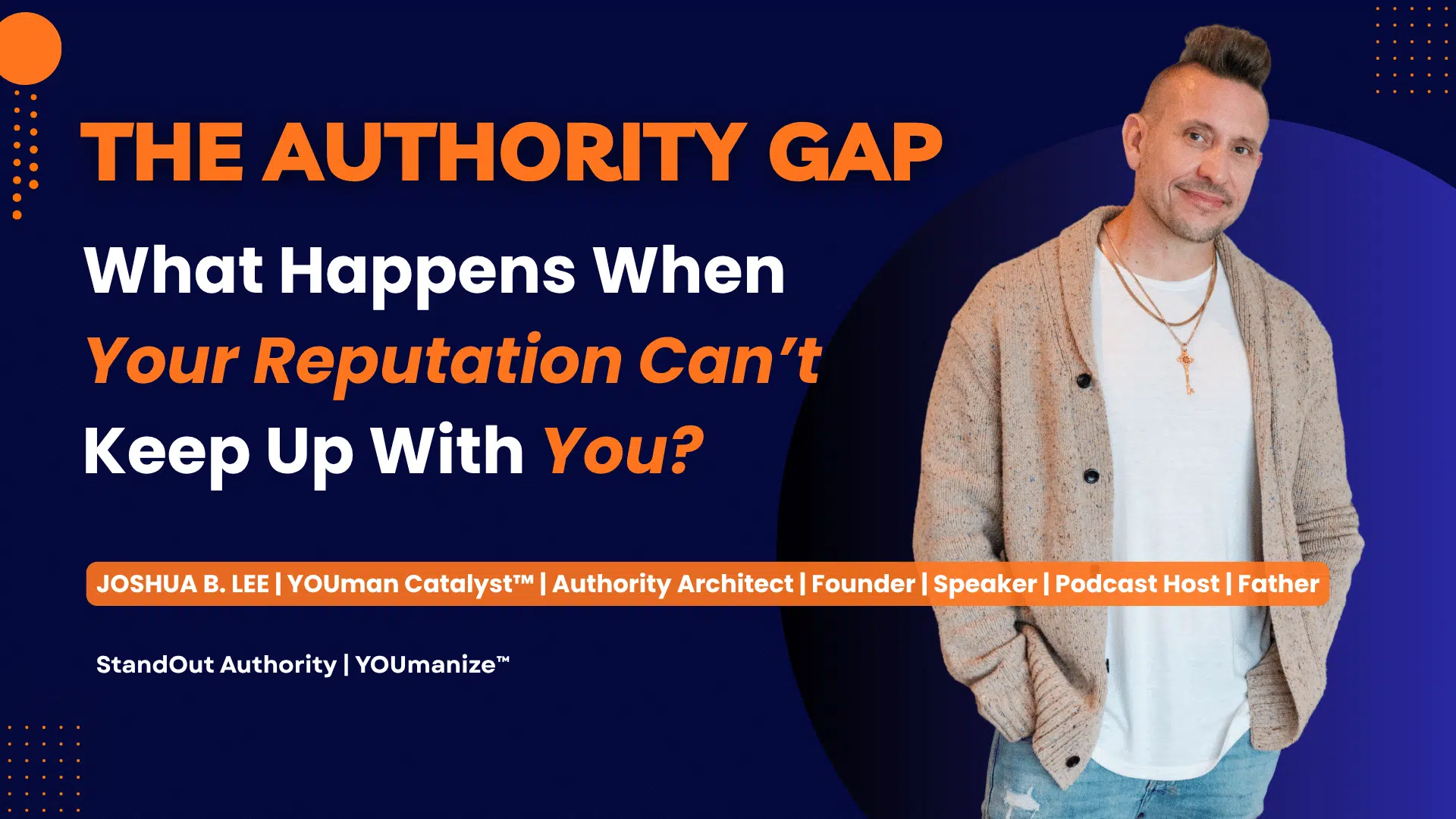
What Happens When Your Reputation Can’t Keep Up With You?
Your reputation can keep working long after you’ve outgrown it, which means the market may still trust a version of you that no longer represents where you’re going.
I’ve spent a lot of my career helping people become known for what they do, which makes what I’m about to admit a little ironic. A lot of people still know me as “The LinkedIn Dopamine Dealer.”
I get it; I spent years building that reputation. I’ve helped founders and executives use LinkedIn to build relationships, create opportunities, grow companies, and become more visible to the people who matter. That work changed my life, and I’m proud of it.
It’s also not the whole story anymore.
The work Rachel and I are doing with YOUmanize™ today goes much deeper into credibility, trust, recognition, and understanding the signals that shape whether someone becomes known and trusted for what they’ve actually earned.
I’ve spent years thinking about why incredibly experienced people can still get overlooked while someone with half their experience becomes the name everyone seems to know.
Somewhere in all of that, I had to admit that I was dealing with a version of the same problem myself. My work had evolved faster than parts of my reputation had.
I don’t think I’m alone.
What Happens When You Outgrow the Thing That Made You Known?
You can outgrow your reputation long before the market realizes you’ve changed.
There are much worse problems in business than having a successful reputation, but success has a funny way of creating its own gravity.
You become really good at solving a problem, people start associating your name with it, and eventually that association begins working without you. People introduce you that way. Podcasts invite you on to talk about it, search results reinforce it, old interviews keep showing up. Someone who worked with you 5 years ago tells someone else what you do, and that person tells another person.
That’s exactly what you wanted to happen, until you change.
Maybe you built another company. Maybe you moved from doing the work to leading the people who do it. Maybe your thinking got bigger. Maybe the problem you solve today is fundamentally different from the one that first made people pay attention.
You kept evolving, but your reputation didn’t get the memo.
I think this happens to more successful founders than we realize because we spend so much time worrying about whether people know who we are that we rarely stop to ask whether they know the right version of us.
The hardest reputation to change isn’t always a bad one, sometimes it’s a successful one you’ve outgrown.
When Does an Old Reputation Become a Business Problem?
An old reputation becomes a business problem when it starts bringing you opportunities for who you were instead of where you’re going.
Your reputation affects the introductions people make, the clients who reach out, the partnerships they think make sense, the stages you get invited onto, and even how someone describes you before you ever walk into the room.
If the market still associates you with the problem you solved 5 years ago, it can keep sending you 5-year-old opportunities. That’s not a visibility problem, people can see you perfectly well, they’re just seeing an outdated picture. We’ve watched versions of this happen with entire companies, too.
Microsoft is a great example. When Satya Nadella became CEO in 2014, Microsoft obviously didn’t have an awareness problem. Everybody knew Microsoft, the harder challenge was changing what the company meant to people after decades of being strongly associated with Windows and the PC era.
The company itself was moving. Cloud became central to its growth, the culture shifted, and over time Microsoft became associated with a much broader version of its business. Today, it’s also one of the companies at the center of the AI conversation.
The name didn’t need to change, what the name meant did.
Founders go through smaller versions of that transition all the time. Your old reputation can be completely accurate and still become incomplete.
Incomplete starts getting expensive when it influences who thinks of you, what they think of you for, and which opportunities never make it to you in the first place.
What Story Does the Market Know How to Repeat About You?
The market remembers the clearest and most consistent story it can confidently repeat about you.
I’ve said some version of this for years because people don’t remember everything you’re capable of doing. Think about the last time someone asked you, “Do you know somebody who can help with this?”
You probably didn’t open a spreadsheet and compare 37 people’s credentials. A few names came to mind because you already associated those people with the problem in front of you.
That’s reputation doing its job. The question is whether yours is doing the right job.
I meet founders who have 15 or 20 years of experience, incredible client outcomes, relationships most people would kill for, and judgment that could only come from actually building something.
Then I look at the signals surrounding them and wonder how somebody who didn’t already know them would ever figure all of that out.
Their LinkedIn tells one version of the story. Their company website tells another. Their bio is still centered around something they did years ago. Their content has wandered into 6 different conversations. Meanwhile, their clients sometimes have a clearer way of explaining their value than they do.
The expertise isn’t missing, the market’s ability to recognize it is.
When someone else in your category has made their expertise easier to understand, remember, and repeat, they don’t necessarily need to be better than you to get the opportunity, they just need to be easier to recognize.
How Does AI Understand Your Reputation?
AI understands your reputation through the patterns and signals you’ve already left behind.
This is where an old reputation problem gets more interesting. AI doesn’t know that you sat down 6 months ago and decided the next 10 years of your career would be about something different.
It has to make sense of what’s available: your LinkedIn profile, company pages, website, interviews, podcasts, articles, third-party mentions, experience, proof, and the language consistently associated with your name.
Humans do something surprisingly similar, we look for patterns, too.
If 10 different signals tell me you’re one thing and you suddenly tell me you’re something else, I need some reason to update the story I already have about you.
That doesn’t mean I think we should all start engineering our lives around whatever ChatGPT might say about us. Please don’t. It means the reputation trail you’ve created matters more because there are now more ways for someone to encounter and interpret it before you ever get the opportunity to explain yourself.
The person researching you and the AI answering a question about you are both trying to solve a similar problem: Who is this person, what are they actually known for, and why should I believe them?
What Does Authority Architecture Have to Do With Reputation?
Authority Architecture turns earned expertise into recognizable signals that help people understand what you should be known and trusted for.
That’s a big part of what I mean when I talk about Authority Architecture. I don’t believe authority is something you manufacture with better content, a polished bio, or a clever positioning statement. Most experienced founders already have years of expertise, outcomes, relationships, ideas, failures, lessons, and proof behind them.
The raw material exists. The problem is that those things don’t always work together.
Authority Architecture is about structuring the expertise you’ve already earned into signals people can recognize. Your experience matters, but so do the outcomes you’ve created, the people willing to vouch for you, the ideas you consistently stand behind, the problems you’ve solved, and the reputation you’ve built over time.
When those things reinforce one another, your name starts to mean something specific, and that’s the distinction I think matters. Expertise can be real and still be difficult to recognize.
Your reputation can be strong and still point in the wrong direction. Your business can grow while the story surrounding you stays exactly where it was. That distance between what you’ve become and what the market recognizes is an authority gap.
How Do You Know If Your Reputation Is Behind You?
Your reputation is probably behind you when the signals surrounding your name no longer match the work, expertise, and direction you have today. I wouldn’t start by asking whether your website looks good or whether you’re posting enough.
I’d ask something much simpler.
If you weren’t allowed to explain yourself, would everything surrounding your name tell the right story?
Imagine someone hears your name tonight. They look at your LinkedIn. They visit your company website. They find a podcast you were on. They read something you wrote. Maybe they ask ChatGPT, Gemini, or another AI tool what you’re known for.
Then they call someone who knows you and ask, “What does this person actually do?”
Would all of those answers lead roughly to the same place? They don’t need to use the same words. Human beings aren’t taglines, and I hope we never become them.
But there should be a recognizable pattern. The same general problem. The same expertise. The same reason to believe you. The same version of you.
That isn’t perfect consistency, it’s recognizable authority.
Final Thought
Your reputation should help the market understand where you’re going, not just remember where you’ve been.
I’m grateful people associate my name with LinkedIn. That chapter gave me relationships, opportunities, friendships, businesses, and a career I couldn’t have predicted when I first started doing this.
I’m also building what comes next, and one thing I’ve had to remind myself is that I can’t expect everybody else to automatically understand where I’m going just because it’s obvious to me.
Neither can you.
Your business can evolve faster than your reputation. Your expertise can evolve faster than your reputation. Sometimes your entire identity as a leader changes while the market continues making decisions based on the version of you it already understands.
Eventually, that gap costs something. Not necessarily because people don’t trust you. Sometimes they trust you completely, they just trust you for the wrong thing.
So before you worry about getting more attention, publishing more content, or becoming more visible, I think there’s a better question worth asking: Is the reputation I have today opening doors for where I’m going, or keeping me attached to where I’ve already been?
___________________________________________________________________
🔵 ICYMI: Does Your Reputation Match the Authority You’ve Earned?
The YOUmanize™ Score helps you see whether the credibility signals surrounding you actually reflect the authority you’ve earned.
That’s one of the reasons Rachel and I built YOUmanize™. A lot of experienced founders don’t have an expertise problem. They have a signal problem. The credibility is there, but the way it shows up across the places people and AI use to understand them doesn’t always tell the same story.
The YOUmanize™ Score gives you a starting point to see how those signals are working together, where your authority is already clear, and where the story starts to break down.
Because before you can close the gap between where your reputation is and where you’re going, you need to be able to see it.
👉 Get Your YOUmanize™ Score